

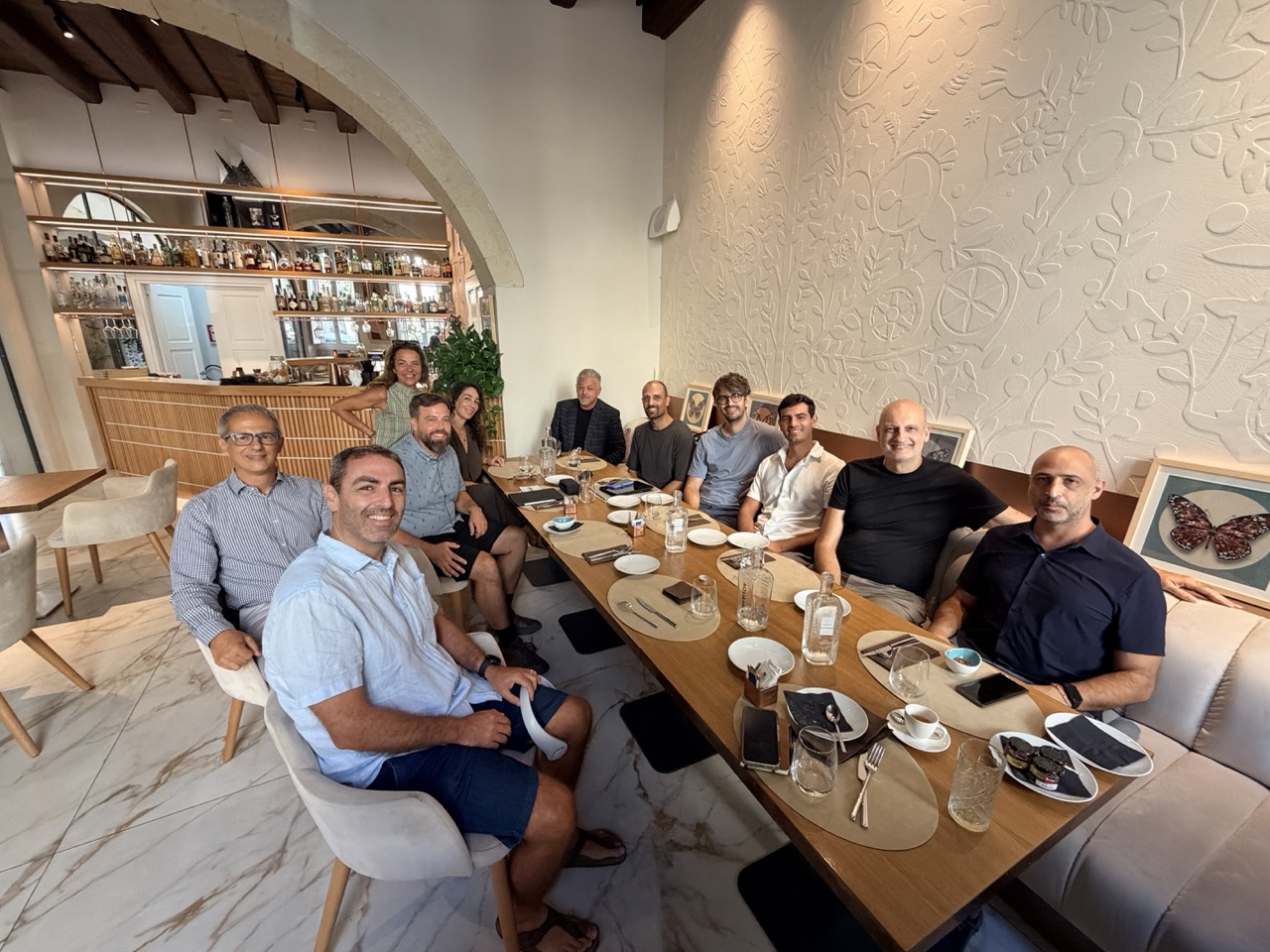
The discussion centered around entrepreneurship, investment, and fostering innovation within Sardinia’s ecosystem.
Open to all · 5 photos · min
/
Transcripts are created by artificial intelligence and checked by humans. Still, errors and inaccuracies may be present in the text.
Chris Okay, and anyone from here? Okay, well, I'll start with it. Nice to meet you, Alfredo.
Edoardo I'm Edoardo and I am from Sardinia actually, so I've been living abroad for several years. Let's say I've come back in Hungary 3 years ago. I started my own property management company and I scaled it from 0 to 100 units in less than 3 years. And that was when I met Vito actually, that is a real estate investor, and he gave us 6 houses to manage, we had a problem in common. Basically, we couldn't know how much we were earning net of everything from each single unit. And not because we were disorganized, but because it's really hard, because you have all the revenue in Airbnb, Booking, Expedia, while all the costs you have in Italian tax tool rather than the banks. So what we did is develop a
software that put all the sources in one unique dashboard. And it's now becoming a financial intelligence that aims to automate end-to-end all the management part for property managers. And we're now— we have around 1,500 units at the moment, and we are raising a round. So this is Dr. House. Okay, you said you were living abroad. Where were you living?
I've been living in Spain, I've been living in Mexico, in Croatia, and yeah, and then I came back. Okay, cool.
Alfredo Yeah, and you're— so you built the platform and now you want to raise money for expanding the platform? Yes. How much do you need?
Edoardo Hey, we are raising $250K in SAFE note, and right now we are at $75K of ARR, and every month in 5 months Everything we've bootstrapped, like, together. So now this month is just to take more market share here in Italy and validate even the investor module. So we made even a module that shows you how much you should invest in a property in order to have the best ROI. So we create even scenarios to test for the different settings.
Alfredo All right, fantastic.
Chris Vittorio, did you want to— I mean, great introduction to the company. I'm a software engineer.
Vittorio I work at Microsoft, different startups, US startups actually. I never worked in Italy. I work from Italy.
And then we also started with some real estate. So you're not familiar? No, I'm from Italy, but I always, you know, stayed abroad or worked for other companies outside Italy. But then I met Edo and we started this gig.
Actually, he's from Padova, but now he's living here.
Alfredo Yeah, I also relocated here for the same reason as you, from what I understood. Cool, all right. Well, I'll introduce myself again.
Luigi I'm Luigi, I run a small software house. We are mainly concentrated in custom software, so we help startups, big companies, small companies to integrate their system or create new apps from scratch.
I also lived abroad many years. Australia, Netherlands, Brazil. And finally I decided, like them, like you probably, to move here because of the energy and the beauty of this place. Yeah, now with Chris helping on this group, I'll leave the floor to the others.
Alfredo Ciao, Sabrina. You want to introduce yourself?
Sabrina Yes, of course. I'm a woman, and very pleasure to be here. And I don't have a startup because my startup is too much head of home to catch.
I have relatives that was an inventor in Sardinia. My parents wasn't Sardinian people, and so my culture was travel, travel, travel, and have a new inspiration. And so I'm very happy to stay in this group because I think that could happen that I have my personal startup in the future.
In this moment, I'm very grateful about you, Luigi, and this group because it's in my connection and in my mood. And also Alfredo, because I think that Alfredo is a little bit ahead of all too, because I like to take care of people that came from abroad. Oh, thank you. To introduce to a new local experience that is not only to sleep and to have an accommodation, but to integrate with many other things that are in this island that for me is magic.
And finish. I'm staying at Sabrina's B&B.
Alfredo It's a really nice spot, huh? Yeah, we ran an event.
Luigi We had an event there once on the rooftop looking out.
Alfredo Yeah, it was great, really great.
Sabrina And I helped them a little bit to manage a part of the group in these events. And this happened for a while, and I was so surprised. In fact, I said, but Luigi, but you give me this present, because I wanted to say thank you. And he said, no, no,
Alfredo, but why you are here? And so I'm very happy because in Cagliari we have a lot of small accommodation. And so very happy about this. Also, this for me is a startup, but it's a different startup, not need money, need emotions. And so
I'm finished. Valeria?
Alfredo Yeah, my name is Valeria. I was born in Germany, but my parents are Italian, and I moved here more or less 4 years ago. And I work in social media or online marketing strategy, do consultancy for German companies. And we do also have like a family business, and we sell— we have our own online shop. We sell Books mainly and courses, and we're trying to access the US market also. So for me, everything like related to investments is super interesting because we are like a small family business. So yeah, I was just happy for this occasion. Just saw it this morning, so signed up last minute. Cool. What part of Germany are you from? Stuttgart. Stuttgart. I've not been there,
but yeah, I heard good things. Yeah, yeah, it's okay. I mean, I would not recommend to go visit if you go for time to Germany, but it's nice to do this one. We got to know some venture funds in Germany that focus on women. Auxxo is the biggest one. They're just raising their second fund. Oh, wow. Where are they from? Berlin. Berlin.
Chris I'm not going to say anything at this point. We can move right along.
Alfredo I'm Francesco. I'm originally from Cagliari, so I'm Italian. I've been working in the blockchain and crypto space since 2014. I had a company in Switzerland offering consulting for tokens and tokenization, and I have concluded my previous experience with this company, sold my shares.
Now I'm going to start a new journey, always in the blockchain and AI field. I'm currently exploring a product with a crypto wallet managed by an AI agent. So this is my new project. I just started it and I'm exploring the opportunities. All right, fantastic.
Mark Hello, my name is Mark. I'm American living here for about 6 years. I have, I think, 2 related things. One is a browser extension around We have a website that uses affiliate marketing, but we bring data on social issues to the user before they make that point of purchase. So political donations, it's mostly at this moment it's all US-focused. So we take FEC filings, we show each company when the user arrives there how much money the company's donated through its PAC and through its employees. It's all public information.
What, how many women serve on the board, people of color, LGBTQ+, it's all public information that different third parties do and bring it to all of our teams. And then more recently, I'm helping a project bring AI literacy to about 1,000 US nonprofits by the end of the year.
Alfredo Amazing. So you're very impact-driven. Yeah, it's fantastic. Good for you, putting together relevant people.
Chris This is a cross-section of the group, but you can imagine with, you know, the numbers that we're starting to arrive at, There's a lot of selection, but then sometimes it's really hard to— yeah, wow, to make the choice.
Alfredo And where are you originally from?
Mark Um, I grew up in Ecuador, moved to Philadelphia for 4 years for university, and then went to DC for 17 years. Okay, DC. All right, wow, I love it.
Alfredo Thank you. Very global. I would like to wait the other guests before to order something, some coffee.
Luigi So I think, I think we can order.
Chris Yeah, this is a good idea.
It's true. So, well, I suppose, so we have questions prepared. Yeah. But what I wanted to propose to the table too is that we're going to try to cover some, I mean, this is oriented around investment. We're going to try to cover some of the core questions that most founders will have. So for you guys, if you've raised before, for example, or if you've been in contact with the VC market before, they may sound quite basic, but I think it's really important that we're trying to set a baseline for the conversation. What I was going to propose to the table though is if any of these questions resonate with a question that you already had in your mind, then by all means add some context.
By all means add some context by bringing up your particular scenario, and then with that I think Alfredo would be in a better place to to give his knowledge on the subject more specific to what you're wondering about, if that makes sense. Does that sound okay to you?
Alfredo Yeah, I wouldn't mind introducing myself. Yeah, please, also.
Chris Don't mean to get ahead of myself here. And I'm wondering about seating.
Alfredo Would it be okay if I just sat at the edge?
Chris You can sit at the head of the table if you like.
You want
to start with a question? Yeah, I can start, but I'm still the one to introduce. Yes, you will. What happened? No, please, the floor is yours.
Luigi That's the good thing of running into public spaces, that sometimes you get a bit of music. This is a beautiful place.
Alfredo I've never stayed here. So it's a hotel, yeah? Yeah, it's a hotel. And restaurant, I guess. Yes, yeah.
Luigi We, we often come here for meetings, me and Chris, so we're thinking that was a great place to have this meeting.
Alfredo Especially for people from outside, you know, they get a good impression.
Luigi Yeah, it's all in the same philosophy of showing the nicest place of the city. Not nicest, I mean, sometimes we go also in smaller zones. Yeah, setups. But you know, knowing the city, eating spots.
Edoardo Oh, there are incredible fish here. Just the fish degustazione, it's like incredible. Oysters and everything. Yeah, yeah, yeah, incredible.
Sabrina I didn't know. Yeah, it's nice.
Alfredo So come here for mussels.
Sabrina And then, and then many years after, decided to open, to open a new branch, branch. Yes, but it is a personal investment, it's not this one.
Chris I don't know. I'd say— That's all right. So short introduction.
Alfredo I'm born in Canada, but Italian parents, Napoletani. And in Canada, there was all— after the war, all the immigrants moved to US and Canada. And I lived in a Neapolitan neighborhood, so I didn't speak English till I went to school. So I can say English is my second language. But Canada was— as I built 3 startups in Canada, but Canada is just not a place for entrepreneurs, you know. So I was stuck at $3 million revenue, a computer gaming company. And then I discovered Silicon Valley, and it was incredible. After living there for 6 months, the business grew like crazy. And then I did an M&A 4 years later.
And that's— once you get the fever, it's like you have to stay there. So I've been there 20 years now and started a startup accelerator called the U.S. Market Access Center. Been doing that for 16 years and it's still very, very active. We have an office in Tokyo and one in Belgium. We just opened in Brussels this year.
We've helped more than 4,000 startups. And 18% of them have raised about $7 billion. So that's on average 1 in 5, or 1 in, yeah, 1 in 5. And 98 M&As valued at about $6 billion. That's where the company sells themselves, so gets sold. And then 6 years ago, I, we look, I, my co-founder, by the way, his last company he exited Amazing. I met him in San Francisco.
One of the wonderful things about the Bay Area is the quality of people. You know, it's unbelievable. And compared to where I was in Canada, it was like moving, you know, 1,000 steps into the sky. So that's why it's such an amazing place. And now with this craziness of AI, it really is detached itself from the rest of the country.
And I know you get all the bad news about what's happening in the White House. I mean, just turn off the volume. It is— it means nothing. It means nothing of what's happening in the Bay Area. Anyway, going back to how Prospera Women got started, 2019, just before COVID we were saying, you know, we're doing really well here. What can we do to give back? What can we do to give to someone. We didn't know who. And then the MeToo movement was just around that time, and I was really impacted by the news. I actually had no idea how bad things were.
And then when you peel back the layers, you know, not so much on the corporate side— I don't understand the corporate side, I never worked for a corporation— but it was on the startup side, women raising capital and all of that. But I couldn't do it alone. I needed a co-founder. Co-founder, and it was hard to find. It's kind of like finding a wife, you know, you have to find the right person that you can build something with.
But I wanted to invest in understanding, so I actually spent— in 2023, I traveled to 17 cities around the world, had meetings with women's groups to try to understand what's going on. And it's pretty much the same everywhere. Of course, there are some extremes, like in Middle East or India, but generally it's about the same. That it's relatively, I shouldn't say easy, but a little bit easier to raise a couple of hundred thousand euros to get started for a woman.
But to scale, it's pretty much zero.
Mark Is there an analysis on why? Doesn't one invested woman scale first?
Alfredo Oh yeah, I can absolutely give you the conclusion. It just boils down to women have babies and that's it. And it stops right there. A woman is going to be distracted and it's all total bullshit, right? So we've had 279 women in our program so far. About a third of them have raised about $100 million. But what we're doing is giving them the front row seat, right? Because usually they don't get that far. So I met Grace 2 years ago, literally on the— on 1 month before InnovateHer in Sardinia 2 years ago. And it was cool. We just immediately hit it off.
She comes from private equity. And then she spent 8 years at the Walt Disney Company in the private equity side and impact side.
And she has her own business and I have my own day job. We have our own day jobs. So Prospera Alpha Ventures and our new fund we announced in March. And it was interesting to hear feedback from different funders, like fund of funds, And being a 100% woman-only fund is actually not a cool thing.
Fascinating. So we've switched it up a bit. So it's women CEO, women on the management team, women co-founder, women on the board. And we're kind of leaning towards at least 50% will go to women. And it's really just positioning. Mm-hmm. It's perception. In June, we went to 9 cities across Europe, Grace and I, just on a fundraising trip in Europe. And that's kind of the feedback we got. It's almost like in the board meeting, you say one thing, and then you have wine and dinner, and you say another thing, right?
So I'm sure I'm not saying anything that's surprising you. So why did we— Why did we just— why are we doing it in Sardinia? Why are we doing it in Cagliari? So about 4 years ago, my other founder and I did a 4-week entrepreneurship program here called Talent Up. It was funded by the Regione, and— Let's pause a moment.
Chris I hear
the shaking. Oh, and yeah, yours is coming up. I was going to say "Is everyone caffeinated?"
We'll wait for yours. No, that's okay.
Alfredo So, yeah, we did this entrepreneurship program, and I've been working, you know, as an accelerator, we've been We'd been doing business all over Italy, you know, Milano, Bologna. We tried a little bit in Naples, but not very successful. But then this opportunity came up here, and I noticed that the culture of the native Sardinians, right, a few of you here, is very special. And I said, this, I could see myself spending more time here. I think that's a great thing. I made out of the 25 kids, I call them kids, you know, they were in their 18 to 25, several of the graduates have started businesses that are operating here and they've become friends, you know. And that's
how we met Chiara, Mariachiara from the university. And we found out that there was some funds available from the region and we said, why don't we do this, let's celebrate your success as building the innovation lab, you know, at the university. And that's what started it. At this point, the mission of that event was really just to bring Silicon Valley people together with European people. It really was just a community activity. And I believe it was very successful.
Edoardo Can you name some of the startups that you found during your fundraising tour? You mean from Sardinia or from the world?
Alfredo From Sardinia. Well, I can tell you their names, but there's been no major tech startup. I think there's one that is doing biomass, like taking waste, biowaste, And converting it into energy. Yeah, exactly. And then the others went on to really just create SMBs, right? And that's okay, right? But it was— I tell that story because of the people, the people that were very unique. You know, we went for aperitivo 5 out of 7 nights a week. I'm not lying. And on the weekends, beach parties. I mean, they treated me like I was one of their brothers, you know. It was amazing. So,
yeah, mi ha colpito molto. It was incredible.
So this year— buongiorno.
So this year the purpose of doing InnovateHER is now we have a venture fund we are raising. It's— the target is $50 million. It is a global fund. fund. So we have verbal commitments of about $1.5 million from Europe so far. That's going to grow. We have about $4 million from Korea and Japan. And we have anchor funds in Silicon Valley.
So it's taking a long time because it's a side job and also because the money is coming from different places. It adds a level of complexity, and I'm sure you know, because you're managing some funds. We've been told to duplicate what we're doing in US and Luxembourg. We're going to wait it out because it's just so expensive. I think it has to be adapted to the ecosystem.
Luigi You cannot just copycat that. Yeah, there's that element.
Chris I mean, and if it helps, all the funds that I've worked with have found that the fundraising cycle has been particularly long in this, in the, let's say, in the past 2 years. So they've probably to have it done in 12 to 18 months, and it took almost 3 years in some cases. Yeah.
Alfredo So we want to start deploying as soon as we have our first $5 million.
Chris Okay, so you'll treat that as like a first close? Yes. Okay, fine. And we're very close on that.
Alfredo We're predicting that by Q1 next year we can write our first checks. Okay. And we already have a big pipeline, you know. Sure. Yeah. So I'll just talk about the fund strategy and then we'll be happy to take questions. So the— as we're building on the success of the accelerator, okay, so I've never been a fund manager. We are actually recruiting a fund manager right now because there's no point in doing the traditional route of waiting 10 years and go, I don't have patience for that. So, okay.
Chris And if you'd prefer, If you prefer a chair, we can bring one over. No, no, it's okay.
Alfredo I just didn't want— I didn't want to crush— My bag is in the way. I didn't want to crush what was in there. There we go. Now we're good. So you probably know all the famous accelerators, right? Techstars, Y Combinator, 500 Startups, Berkeley SkyDeck, et cetera, et cetera. They're all around the same in that they're 3 months long. And I have to tell you, you know, 3 months, if you are American, 3 months is perfect because after the end of the 3 months, you know what to do with the resources you've been given. If you are from outside, even from Canada, which is similar to Europe than U.S., it's not enough. You get introduced to
potential customers or partners. You're just getting started. And the way Americans make, build relationships, the way Americans sell and do marketing is nothing like the rest of the world. So our observation, again, after doing this for 16 years, it's 100% failure after 3 months. Wow.
Because it's not enough time. So the only ones who really are successful are those who out of their own pocket continue to come back and come back. You know, building a relationship with a big customer, you don't do it on Zoom, you don't do it on phone, on email, you have to be in person. So anyway, we did an experiment. Do you remember before this was the BlackBerry? Anybody remember that? Yeah. Okay, BlackBerry is a Canadian company. Now when this came out, BlackBerry died in about 3 months. And, you know, I'm Canadian originally, and Mike Lazaridis was the CEO of BlackBerry. He had a difficult time for 2 years. But the conclusion—
why did BlackBerry fail? It wasn't about technology. It was about sales culture, right? And the fact that Canada cannot produce strong management teams. So he set out, he put $25 million of his own money, he got matched by the Ontario government, so he had a $50 million fund to start what's called the Lazaridis Institute to make— with an objective of making better management teams. We won the contract to design with a blank sheet of paper the mother of all Excelerators, in his words. Now, his objective was to make better Canadian managers. He did
not anticipate the following. So we did 2 cohorts for 2 years, and then we taught them how to run it themselves. That didn't go well, but for the first 2 years it went very well. 930 applicants.
Profile needed to be a company doing at least $500,000 in revenue from Canada. Now Canadians are not like Americans. Canadians are like Europeans. Lots of public money, lots of relief funds, you know, doesn't have the same culture as America. That's why there was this challenge. So we had top 10 for year 1 and year 2, so 20 companies. So out of the 20 companies, 16 of them raised $2.1 billion. 2 of them got acquired for $180 million, and 2 of them became zombies.
If you look at the portfolio of any fund, out of 20 companies, you do not see these results. Why? Because this program was 1 year long. And it had no— not just one mentor or one salesperson, it had a team. So what we did, and now we have a lot of funds that are interested in working with us because they want to see these results. What's happening now is there are too many funds in Silicon Valley, 3,800 funds, imagine that.
There are too many funds chasing too few hot deals in AI with the race for dominance. And the truth is, I don't know what the exact number is, but I'm guessing the top 100 funds get the best deals. That means 3,700 funds are not getting them. Just in the last 14 months, there are 68 new funds.
So what's going to happen is— well, what's happening now is these funds are starting to look outside, okay? That's cool. But most funds don't know how to look outside because the number one challenge you all have is not about your technology, it's about culture, 100%, right?
Competing with Silicon Valley sales teams is a very difficult thing to do. And so anyway, but we know how to do that. We've got 16 years doing that, helping people navigate the culture. When we present our startups to the top-tier funds, we have 55 funds that we're close to. They don't care whether they're from Indonesia, Indonesia, Brazil, the Arctic, it doesn't matter. They're ready to go, right? Right now, because all they care about is you are Americanized and you're ready to do business. That's how it works. Americanized in terms of culture or also setup?
Luigi Good segue into my next and
Alfredo final comment. Yeah, so culture is number one. But then there are 3 practical things you all need to know. If you want Silicon Valley money, number one, you have to have some American customers, okay? They will not invest in you to get American customers. You need to get money from the EU, mom, dad, uncle, grandfather, whatever, to get your first American customers. You will get funded to scale. To say, oh, you've got a few American customers, now we'll give you money to scale that.
Chris Right? It's different. So number one, you need some American customers.
Alfredo Number two, you need to have a Delaware corporation. That's easy to do, but it's— the $300 fee is not the hard part. The hard part is you need some advice from lawyers, American lawyers, because corporate structure is important. For example, if you have IP that comes from a university and maybe they have a stake ownership, you need to clean that up.
We had one company from Spain that had 18 founders. That's messed up. Okay? That is not going to work. I can imagine.
Chris So you need to clean that up
Alfredo and that's why you need the advice. Also, if it's an online business, Where does the revenue come from? How do you get taxed? So you need to get advice on that. And then the final thing, and this is often the deal breaker, is one of your decision-making management has to relocate and live there. The reason for that is because Silicon Valley investors don't invest like in Las Vegas where you just put the money there and hope. They have strategic involvement in you, right?
They will introduce their portfolio to you as potential partners. They will introduce you to law firms,
tax consultants who have their clients, right? So it's a very hands-on relationship. And Chris, and I'm sorry, I forgot your name. Mark. Mark, you would know very much what I'm talking about. It's an in-person
So when good times are good, you want to be close to them. When bad times are bad, they want you to be close to them because they're going to come to your house and strangle you. So anyway, that's the background. Sorry for talking so much, but I wanted you to have the full context.
Chris And I know you've already touched on some questions that we had. So it's very "in tune". I have a question.
Luigi Considering the ecosystem of Sardinia, most of the companies here are small to medium companies, right? So my question to you would be, when would it make sense to grow organically versus finding investments?
Alfredo So I get asked this all the time. Time, the Japanese have been probably the smartest in helping them to figure that out. So the Japanese government sponsors one of the programs that we run. It's simply called a mentoring program. So we know that mentors exist all over the world, but the quality of Silicon Valley mentors cannot be compared because we have a community of 150,000 people. More than 2/3 have built and scaled a company and had at least 1 or 2 M&As. The other— and more than half are investors themselves. And they're categorized in different sectors of expertise, you know, agriculture, food,
robotics, you know, so many different areas. And 1-hour conversations with one of these people can help you shift your mind. Because we understand it's not just Cagliari, just everybody, even in Barcelona. Like, you don't have access to people that have done these incredible things. So you're limited to figure things out on your own. Yeah, you have advisors, you have some people you might know, but it's very different. And I'm not saying this because I live there and operate this business. This is what everyone tells us, right? This is what 100% of our startups tell us. The caliber of mentors cannot be matched. So it would be amazing. One of my missions is to find out, like, did
you know that EIT is setting up an office here? So they're one of the European Commission's entities, and I'm going to give a talk there tomorrow. I didn't even know it existed. And it's one of their first meetings. So EIT, then the Regione di Sardegna has— I have known some people there. They're funding part of the Innovit Hub. There's money. If we can get a mentoring program sponsored, even if it's 5 hours for you guys, 5 hours with some of the Silicon Valley guys, it'll change your life. It'll change your mindset. that you will have introductions to people. It's not gonna finish it, finish anything, but it'll help you to
get your focus. The last, the worst thing happens is you spin your wheels for a year with assumptions. And yeah, you can get data from the internet, from, you know, ChatGPT, whatever. That's not the same. Right now what's happening is just madness. We are helping on any given month 10 to 20 startups per month.
And the mentors, our mentor community fuels us with the knowledge that is outside of what you get online, right? Because they're actively pursuing. So I know that's a long answer. No, that's good. But the best time To start raising capital is when you understand, when you are absolutely sure what your value proposition is and who your competition is. That's the other part.
You've got to have access to tools like Crunchbase and PitchBook to understand who else is doing something similar.
Chris Thanks. It's really important to really know your zone. If I could add in something Just to try to characterize this a little bit more. One of my observations with companies here is that it's quite easy to end up in the equity gap as well. So is everybody familiar with this concept, the equity gap? No. Okay, so, and correct me if I'm wrong at any point in what I'm saying. Essentially, the concept of the equity gap is that if your company is early stage enough, or if valuation is low enough, if you're looking to raise money from a fund or even an angel, If that $50K that you want to raise is large enough within your valuation that they would be taking a crazy stake in your business, then it doesn't make sense for you or for them. So, a $30K offer— and by the way, I've heard of some of these
offers coming in. It's ridiculous. From here specifically. In fact, my wife had an offer for $20K, and they wanted 30% or something.
Alfredo What? Call the police.
Chris No, she's like, just punch me in the face instead. What is this offer? But basically, if you're in that kind of scenario, in my opinion, you really should start on a growth path, or at least build up a product proposition or a business proposition that can elevate you to a point where it makes sense to both sides. And we see a lot of people that are just at the early stages, they may not understand very well, or they may not understand their own business well enough to be able to put forward a proposition that would make sense for an actual offer.
Alfredo So you're talking about valuations?
Chris Yeah, we're talking about— well, I am talking about valuations, but I'm also talking about the maturity of the business, whether or not they can even see revenue, do they know their customer. So, as you know, it's certainly about finding your competition and understanding the marketplace. It's that product-market fit problem. Which is kind of top of the list for failure rate as well within a business, right? Within a startup. So there are all these points you need to map, but I think businesses here specifically need to be able to build around the idea that at some point, if you're going to raise, you really need to be in the right zone.
Alfredo Yeah, so the valuation, that's— I can't even believe that's possible. I thought that was the old days.
Chris I'm pretty sure it's still happening.
Alfredo We work with a lot of companies in Poland and Czech Republic, and you would get $150K for 50% of the company. Yeah, because you can't— those days are gone, you know, we believe. But the typical is, you know, you would get maybe $200K for 5%, you know, something like that would be typical. But you have to look at the source. Right now there's a lot of EU money, right? And for For women, there's a— we are an associate partner from the— it's called WomenTechEU, but it's for deeptech companies only. You may qualify, I don't know.
And you get €75,000 for if you— they have a lot of money. But we're trying to lobby with them as well. That's why we set up the office in Brussels. We have a great team there.
So yeah, so I am passionately— I can't wait to move here part-time and make an impact. And what a gift. I mean, I had no idea you guys were here, you know, that you created this organization. That's the whole point of this group is actually let people understand There is talent in this island.
Luigi And the talent is everywhere. You just need to put it together and cooperate and find a way to— Something that we push hard,
Chris yeah, is cooperation. And we try to remain agnostic to any sort of politics that are here because we feel so long as the mission aligns, which I— we spoke about earlier, which is to put it on the map, make sure when people get here they feel like they can belong and do the work they need to do. As long as we're mission-aligned with anyone, We feel like there's a partnership there, and we don't need to get caught up in anything else.
I feel like it's a clean approach. Yes, thank you for the kind words. We believe strongly in this. That's why we're all here doing this thing. For me, the sky's the limit. We were, in a way, almost operating in stealth mode for the first 18 to 24 months, and now we've really pushed it. But there's perception.
Alfredo When we did InnovateHer two years ago, when we invited the VC community in Europe and many people from New York and Silicon Valley, I received at least 1/3 of the responses, what do you mean? That's a resort island. That's for relaxing, not for business. Like, okay, we need to change that. Yes. We want to do both. And now this year, 2 years later, We see the shift is happening, but slowly.
Chris But also imagine a lot of our members are in the hospitality sector. If we had come in and said we're tech only, high growth only, startup only, then you would alienate a large percentage of the people that are actually operating businesses here. So we've had to also take this, and we want to take this approach of being open-minded, supportive, and have that full spectrum. Well, look, we have agriculture.
Alfredo And the marine, right? The marine industry? Yes, of course. And I know that there's this agreement with Japan. They fish a lot of the tuna. Yes. Yeah. So I do a lot of business in Japan.
And they come and fish. They flash freeze it. And they sell it for 10 times the amount. And they will pay for it. It's different tuna here.
Chris Stepping into a Japanese supermarket is quite the experience. Like, every piece of fruit is just perfect because they only take the best. Yeah. The fruits— You were just saying? It's just great. Shall we put forward another question? Yeah, yeah, more questions. Yeah, open it up, guys.
Alfredo Thanks for sharing all that you're doing. I was curious, well, 2 things. One, how does Sardegna rank amongst the ecosystem? Like, are we behind first tier, second tier, just out of like amongst your model of doing it? And you talked about the Delaware and the legal stuff. One of my biggest frustrations is the bureaucracy here. Here, yeah. So obviously money equals talents, but I cry, laugh, both dealing with the bureaucracy of accomplishing basic living things here.
And I was wondering, how does your mentoring— like, they're like, I'd like to, but it's going to take like 5 different signatures or 5 more months for me to get that form to be able to do that. Yes, I mean, I know it's not just Sardegna, it's not just Italy, it's Europe in general. Like, you know, we set up the entity in Brussels and it was relatively easy. Relatively, um, probably easier than France or Italy. And I heard Germany can be quite tricky.
Getting worse. Getting worse, yeah. So I think we just gotta look at what is the MVP, like, to get it done. Now I'm not talking about home renovations or citizenship. I mean, it's taken me 14 months to get my citizenship and I still have another 14 months to wait. Amen.
Luigi But what seems— yeah, 14 months is good. It's a good time. No, but it has— 14 months has passed.
Alfredo I have another 14 months. His answer remains the same. But for business, I think, you know, you just need to understand what the conditions are, right? And we cannot change, things are getting a little bit easier, like EU ink., it's some interesting rules that came out of that. But I think the biggest, so we had 3 EU commissioners come to San Francisco for open forums, and it doesn't matter what their agenda was, everyone's questions were the same.
What about the labor laws?
And that's, that's a tricky one, right? Because, you know, California is the opposite spectrum. I, I can hire a team tomorrow and I can fire them all the next day without any conflict. On a Zoom call. Yeah, yeah, with a 10-second call, you're fired. Yeah, so, and then here, of course, it's tricky.
So I think, but there are ways around it, right? You do contracts, you do long probationary periods and all of this stuff as much as you can. I'm not saying that's good for the economy, but you have to focus on your business first.
So look, I got, there's no magic wand solution. It's frustrating. You gotta work within these restrictions. But building a global business, I mean, Luigi has people all over the world, right? But no one is Sardinian. No one is Sardinian? And sorry, where does Sardinia rank in your ecosystem, your portfolio?
Where would you put it in the timeline of evolution perhaps?
I mean, look, I mean, do you know that according to Forbes, According to WEF, Italy is in last place for tech innovation, okay? Like, think about it. Last place. Number 17. The next one is Bulgaria, 50. That means Bulgaria, okay, no surprise, but everyone else is higher than 50.
Okay?
I'm not saying there's no talent here. It's just, I would say France, Spain, Italy, Portugal, Greece fall into this Western Europe, old Europe mentality. Too many government safety nets doesn't breed entrepreneurship spirit, right? Then you have unforgiving banks. You go bankrupt. You're punished for life. Your parents wanna kill you. Like, you know, it's not cool. But, you know, what are you going to do? I know in Poland, in Czechia, not Hungary and Slovakia, but Poland and Czech, they've made it a little bit easier if you have a failure, right? So, and I don't know what's happening in Germany, but— They tend to do better now. Better now? So the banks don't punish you for life.
So those things need to change, right? But anyway, going back to your question, I think we have the biggest opportunity The only way is up, says the optimist.
Chris I think for me it's a case of also literacy. So I do some work with schools as part of what I do, and it's something I'd like to do more in the future. But speaking with teachers, I can see that literacy is such a problem that teachers don't understand how to use technology well. which has the knock-on effect that the students don't learn to use technology well aside from these, which does not give you the underlying knowledge of how technology works.
You only get the surface layer. So I think for me personally, growing up in South Texas, we had computers from the time I was like, I don't know, 5 or 6. We would spend time in a computer lab learning how to use computers, and that went all the way through to college. So, you know, I may be talking about something that's 15 years in the future, but if we start today, we may also see things can improve.
Alfredo I know, but it's a double-edged sword too. I think that— I tell a joke, you know, if it's my son's birthday in Italy, I'm going to take 5 days holiday because we have 10 parties to organize. In California, maybe you call your son for 10 seconds, happy birthday, maybe. So there's— is that good? No, it's just different, right?
And maybe Germany you take an afternoon off. So there's a balance. Are we going to have fun during these 10 parties to celebrate my son's birthday? Oh yeah, we're going to have lots of fun. But business sort of slows down.
Edoardo What I mean, there is I'm saying because I've been living abroad for several years when I used to work with the US people launching products in Italy. Like, we have so much competition with the US people, but now here opening in Sardinia, there is no competition. Basically, like, you know, the best in one second. I mean, this is my experience, so it's much easier from that side. While there is all the complexity with bureaucracy, etc., etc., but once you solve that, then It's done, no? Like, it's easier. I don't know, that's my point of view.
Alfredo Yeah, so I'm glad you brought that up. You know, when I was in Canada, I was a big fish in a small pond, right? And there's nothing wrong with that, right? And there's— because if you think about it, out of 100 MBA students, who's gonna start a business? The average is 2%. And then some of the more advanced universities, it's like 6%, right?
So what we're saying is, look, not everyone has to build a billion-dollar business, but use Silicon Valley as a learning platform because it will change your mind. Now, AI already is helping so much. You, you can avoid wasting time in certain areas, but the The face-to-face, in-person activity is very different. And the rapid learning environment of Silicon Valley just by being there, right, is unbelievable. We tracked, of our 4,000 or so startups that we helped, we tracked them.
Those that raised capital, it's like 1,200 of them, only 1/3 set up an office in the U.S. Think about that. That means the rest learned,
garnered the right contacts, the money, the customers, and set up elsewhere. So they used it as a learning platform. So the positioning is also very good with the EU. Because I don't know if you know, but now they've— EIC is coming up with a multi-billion euro Scale-Up Fund. And they came to Silicon Valley and Singapore, just these 2 places in the world, saying we need your help. Singapore because they want to access— Asia. Good luck, China. But even— Japan and Korea, I believe, is a better choice than China.
But they came to Silicon Valley for the US market,
and they admitted, they said, we spent tens of billions of euros investing in 800 scale-ups and almost zero results. What the f— you know, that is horrible and embarrassing. But why? Why does this exist? Because It's a cultural barrier, right? Because we take 5 days to celebrate my son's birthday, we're not focused on building the business. Now, I know I'm talking in circles here, but what is the solution?
Is if we can— I believe the next crisis is going to happen in the universities. I think it's coming really soon. Yes, I agree. Because most of these professors have no idea They've been there 25 years teaching something from what's on the wall in their shelf with the dust, and they have no idea how to even— they don't teach entrepreneurship. So one of our other divisions is called the Innovation Dojo. We have a strong partnership with UC Berkeley, several of the faculty.
We now just last month received the authority to give UC Berkeley diplomas with our program. And it's to introduce a 3-week summer entrepreneurship program. You cannot during— you cannot insert it into a university's curriculum because these guys will not allow it, right? Yes. So you do it in the summer. You'll have a nice almost 3-month period. We've experimented it. We did one in Nice, one in Batumi, which is on the Black Sea near Georgia. And— I've been to Batumi.
Edoardo The whole idea is to have at least 100 to 300
Alfredo kids and they do idea to MVP in 3 weeks. And the percentage of the graduates that actually created operating businesses is very high. And this is— and imagine you get a UC Berkeley diploma on that. Wouldn't it be cool to do it in Cagliari, right?
Luigi That's mandatory to do it in Cagliari. Luigi is saying it's mandatory.
Chris So we pitched this to the
Alfredo Regione about 3 years ago before we had the Berkeley Certificate Authority. But now, so this guy named Massimo Timussi used to be one of the big guys in the region, and now he's working in Rome in Parliament. And Chris, my other partner, is meeting with him next month in Rome.
Luigi So it's happening? It hasn't happened yet, it's next month.
Alfredo But we're going to propose this then. So, let's make it happen in Cagliari, right? Yes, please.
Edoardo Let's make it. Any, any way we can support, we're already there.
Chris We were thinking about
Luigi structuring something similar, but obviously we don't have the house, we don't have the ground, the connections.
Alfredo And you need the brand, right? Because of course the brands right now. There are 2 universities in the world that produce more entrepreneurs, Berkeley and Stanford. It's public information. So where do you want to go? Hey, Daddy, can you pay for this? Yes.
So the way the model is, it's you need ideally 300 kids. When we did it in Nice, it was 300 kids because you had enough surrounding Okay, the anchor university, I did 100 kids, and then you invite the surrounding cities. Why is Nice good? Because it's a resort town. So after, on the weekends when you have a break, you can enjoy yourself on the beach. Cagliari is the same. Much better than— Much better than Nice because it's Italy. Yes. And then you invite the surrounding neighbors. Like, so you have North Africa, you have more of Italy and France, you know, Corsica, Spain. Yeah, so let's make that happen. Yeah, so actually I want to throw something in there.
Chris When I'm not doing my day job raising a family or working on Entrepreneurs Unite, I do research on startup ecosystems. So I've been reading a lot of Brad Feld and some other research in that area. And he talks a lot about diffusion, right, and early markets too, because Boston had an ecosystem of its own, some would argue even before Silicon Valley emerged. Texas had strong semiconductor and tech quite early. But the thesis that Brad has put forward is that each market will take on its own flavor of entrepreneurship naturally, because you need to fit the culture. of the local environment. But the feeling is that there are parts of what is seen in Silicon Valley that can diffuse, that can be
transported to other places. Do you agree with that? I mean, do you think— and I want to add another layer on top. My thesis is that through the quality of life here and some of the thinking about longevity, there can be a flavor of that here that is truly unique in the world. Do you, do you see something in that thread? 100%. I think so.
Alfredo We spent quite a lot of time studying this, and even when we were pitching it to Massimo 3 years ago, we looked at the whole longevity industry. Yeah, you know how much money is being invested in longevity tech? Yeah. And wouldn't it be cool if Sardinia was the world, you know, we created a research center just on longevity, you know, that would be amazing and all the spinoff that would happen. So I agree with you.
Now the other thing, so Chris, if you meet him, he's my other partner, he's obsessed with building better founders, right? And it's not about building Silicon Valley founders, it's about be a little bit better founders. And if you study all the reasons why Silicon Valley has so many success stories, it's because you're living in a dense area of dense resources, right? And of course you can say, oh yeah, yeah, whatever.
But founder— repeat founders, right? Second-time, third-time founders have a higher success rate. And in Europe, you basically have 3, you know, Revolut from the UK, Spotify, and Skype. You know, Skype— Bending Spoons.
Luigi Bending
Alfredo Spoons? Yeah, so you have some of them, right? Unicorn. But the point where the first 25 staff members learned they will never learn from MBA, they learned what 10%, 20% growth per month is like. That kind of experience changes you and it gives you the prerequisite to start something new.
Like Revolut had, I think, 32 spinoff startups because those guys were there. Now Silicon Valley is Pretty much everyone. And that's why you see the PayPal Mafia, the Tesla Mafia, all they call them mafias, but it's the relationship network from those first 25 to 30 people that were in the company. So what we've instilled, what we've included in our Berkeley program is the instructors are not professors. operators, previous operators of rapidly scaling companies. And it's a very different experience. I've not had that experience. Chris
had that experience. They were at one point, they were growing at 23% per month.
Chris It's like a bomb going off. It changes you, right?
Alfredo So that's a cool thing to work towards. But imagine if you had a program like this in Cagliari. Then within 1 year, the word would spread and Bocconi is no longer the big name in Italy, you know. So let's make it happen,
man. I think that it's— in my personal experience, it's very difficult for me to I'm not explaining in English, okay?
Sabrina And so, be patient. But I did 20 years of experience in a company that have a big, big investment from Brussels or a regional bank, okay? And there are a lot of companies that have a mix of investment. That was— that came from North Italy, and the condition is to have an agreement with local entrepreneurs, okay? And when I arrived here, also very good entrepreneurs of North Italy, of
Veneto, arrived here and changed a lot of things. And 90% of companies die. 90%. And I collaborate about this because I did the business plan and I follow all different cases. Yes, because I asked myself, but why? Because the money wasn't the Absolutely. And so I learned, I learned properly because I was very curious if the money— many people think that the problem is the money.
I'm totally, after this experience, that the money is not the problem. Yeah, money is not the problem.
Alfredo What's good if was the
Sabrina problem? Money is a piece of paper that arrives step by step is a consequence. And so when you talked about mentor and when you talk about people that do the mentor, okay, this is the possibility, this is the challenge for me, but it's a little bit It's a little bit complicated because— not complicated, complex, because like you said, needed to be in person, apart. And the other one is that this is in my experience, and I hope, hope, hope, because also inside the university maybe
20% have this vision because all is in theory. But in the practice— When you connect with the right mentor, I'll give you an
Alfredo example. One of our recent success stories for InnovateHER, for Prospera, is a woman from Japan who is extracting nutrients from seaweed, and she created a nice nutritional drink, but she didn't know what to do with it, how to commercialize it. So one of our mentors, his name is Mike Dolovish. He works in the nutrition industry and he's got the strong ties. California is the place to launch a drink like this because very health-conscious and people experiment with different things. And because of that connection, you know, she literally spent 30 hours with Mike over 6 months and now she raised $15 million and she's selling all over the United States, mostly in Los
Angeles and the West Coast. But— and it's a nutritious drink. But those kinds of things, you know, how do you commercialize an innovation that, you know, Japan market was not the place for her, you know? But it's because of the mentor. The mentor opened the door.
Sabrina We had in Sardinia 2 examples, very interesting. One is is the investment in the beer, Ichnusa beer. Okay, this is a case, it's very interesting about what happens. Okay, and in the last 15 years, Ichnusa is present in each part of Europe. It's everywhere. Yeah, everywhere. And Ichnusa is a Sardinia brand, so for Sardinia tourist area, it's fantastic and a good opportunity that I think that people not use it. How can use it?
Okay. And in these cases, there is a leader that is Heineken. Heineken from Holland have plan, invest money, but keep its strategy unchanged. Okay. And another cases of very good results in Sardinia was the investment of Ryanair, the investment of cruise, the cruises, ferries. And we are lucky about the crisis, okay, because arrived much more and the war. And the last
example of a very good successful was many, many years ago when doesn't exist the internet and Nicola Grauso, Nicky Grauso, the founder of the newspaper in Sardinia, L'Unione Sarda, bring after his experience abroad video online. Okay, and but All these experiences, what have in common? Have in common a leadership very strong and straight. If exist this in Sardinia, can happen a miracle also for many other people.
But need to know, because without this, we lose. Energy, illusion, money, and everything else. Need a vision, and not a few, not a few people, but very strict. Because like you said, we are very lucky about the weather and the climate. And la dolce vita è il dolce far niente.
This is somehow ours. We are.
Alfredo So, Chris, when do we wrap up?
Chris We're going to wrap up quite soon, but I was going to see if you could take one more question on this thread, or should we just close? No, no, I have time. It's up to you.
Alfredo You wanted me to say something about Innovate. I do, yeah.
Chris So officially we were closing in 15 minutes, this particular event, but it really depends on your time. So we can either scrap the question and jump to Innovate. No, you're good until 1 o'clock. Okay. I wanted to draw upon your experience. We've heard about leadership just now, but one of the questions we had in our preparation materials is around the idea of we have a— let's say hypothetically a business owner is here.
They would like to globalize or reach other markets, something I'm sure happens in Canada as well or any smaller market. Have you noticed any consistent patterns, or we could call it a recipe perhaps, or maybe some key points that a business owner or a founder should really be hitting in order to get to the point where they can spread that business outside of their local market. And the final piece of that is, is it possible to maintain your HQ in a place like this after that move has been made? You talked about setting up in Delaware, for example. That's completely understated.
I mean, you need to have an entity where you're taking money if you're taking on investment.
Alfredo Yeah, I mean, there's a difference between a global business— And a multi-market. And a multi-market business, yeah. So you can totally have your HQ here, but, you know, if you want capital from the United States, you have to be there. That's just That's just the punto final., you know. So, but, you know, you need to do your own market validation. You have to have revenue where you are here, and then you have to, you know, the typical Lean Canvas, you know, what are the assumptions you have about other markets, and you have to go talk to customers in those other markets.
So you kind of know that's But how can I answer better? If you have a more concise question.
Chris I think, you know, I'm thinking, yeah, I understand it was a broad question, but, you know, if you can look back at some of the success stories you've had more intimate knowledge of, is there any commonality between some of those success stories you've seen? And particularly, I think it would be interesting if they were in different markets. So like, they could be a quality in a founder, or it could be one particular core business metric they hit that meant that they could move from single market to multi-market. Let's scrap the global element because I think that's far too large.
Alfredo But yeah, I think, you know, entrepreneurs in general are a little bit crazy. You have to be a little bit crazy to choose to— like, I, I would— I explained it to my parents and they still didn't understand— is that I would rather have the stress of not knowing where my next $100,000 is coming from rather than the stress of reporting to people I don't like, right? And, and that's right, there's 2 different things. You spend 60% of your time in a big corporation dealing with politics. Not everyone can do that. So you have to be a little crazy to leave the steady paycheck and start something new. So
good founders, strong successful founders, have the ability to focus and to be customer-centric, right? Now, what does that mean? If you observe all the success stories across all the cities of the world where there are entrepreneurs, the most successful startups have a co-founder, right? And I'm talking about tech businesses, okay? Not just SMEs.
You have a person responsible for tech, CTO, and a business person, right? It's very rare you have that same qualities in one person. And investors prefer the mixed team because the business person is responsible for selling a vision, not for selling what is working today. And the typical engineering, computer engineering student has been taught to strive for perfection. And perfection is evil because by the time the product is perfect, your competitors have already surpassed.
But you need both disciplines to work together. I've been together with my current founder for 16 years, and we are very different people, but we know that 1 + 1 = 3, not 2. And so that's hard, you know, finding the right co-founder is very hard. Anyway, going back to the ingredients of a successful founder is the mindset. The mindset to not seek perfection, seek good enough, and always be in touch with the market. Right now is more critical than ever because of
AI that your assumptions are only good for maybe 3 days. So you have to keep talking about what you're doing to get the feedback. You need the combined online data and in-person data. They're 2 different realities. need to come together.
Anyway, you know, we can talk for hours about this. Sure, sure, sure. And that's part of the workshops that we teach. But I wanted to take a moment to talk about InnovateHER. Even though it's celebrating women's entrepreneurship, we totally want to encourage men to attend because the challenges that are experienced by women entrepreneurs are because of men. And most Most of the— I know it sounds weird. But it's true though. But if you look at all the women's groups, all the women's funds, all the women's organizations, most of them are 100% women.
they're doing a great job. They're helping each other. But we need to be part of that solution. And not all of us are bad guys. In fact, most of us are good guys. But we don't understand, right? We need to understand. And the other reason why you should attend is because you're going to meet about a dozen investors from Silicon Valley who are handpicked. They're LPs in our fund.
And about a dozen investors from Europe that all share our same philosophy, paid out of their pocket to come to Sardinia. So I think you will, you'll have very interesting networking.
When is that? Friday and Saturday. It's a weekend. We'll post on the group.
Chris We're going to put a listing up. But the best step is to go on the site.
Alfredo You need to register. You will be approved very quickly. Everyone is welcome. It's courtesy of the University of Cagliari and the region of Sardinia that's sponsoring it. concert because they have to do the catering for food and coffee and everything. But innovateur.com, innovateur.com.
Chris And guys, we'll put a post out today with a link to their site from ours, if that's okay.
Alfredo Of course, yeah, yeah, we're encouraging it because our target is 300 people and we We are only at half. Okay, well, we'll bring as many people as we possibly can.
Chris Amazing. So yeah, guys, please sign up. And I can confirm that I got my response in like 2 hours.
Luigi Yeah, it was very quick. Yeah, it was quite quick.
Alfredo Yeah, we get an alert, about 6 of us get an alert on our phone, and it's a race who presses approve.
Chris Same kind of point, is there anything that as attendees we can do well to help to make this event a successful one for you guys?
Alfredo You know, like I said, I had no idea you existed. And the fact that you have gathered a collection of people who share a similar philosophy, those are the people we want to attend. And the fact is, you know, I'm here for life, you know, so I'm not just coming in and having a good time and going home. So I look at this as the beginning of a good relationship. And yeah.
Chris Okay, appreciate that very much. If you are staying, Sabrina was right, you should register then.
Luigi Become a
Chris member of our community. Sure, yeah.
Valeria We just launched a website, no?
Chris We have been working very hard to make this, take it to the next phase. So yes, please, we'd be happy to have you. Amazing, thank you.
Alfredo And I am leaving on Sunday though, so I've been here, I got here Friday. Sabrina, lots of WhatsApp messages.
Sabrina I have a totally different approach about the welcome.
I'm very happy. I can't wait to meet you. So the time is short.
Alfredo Yes, but I have little bits of free time from now until Friday. And then most of my team comes on Wednesday night, Thursday morning. So Thursday is pretty much full preparing. But, you know, I have pockets of time between now and Friday.
Luigi Wonderful.